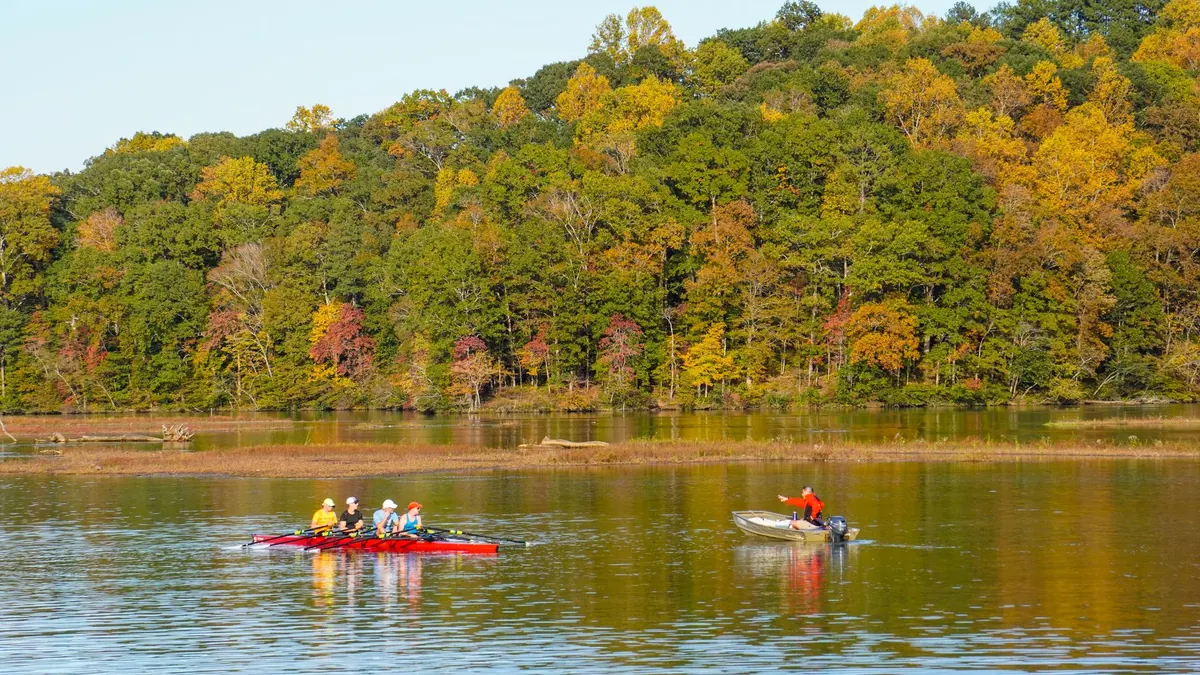
Your first head race will not look like the regattas you have watched. There are no lanes, no side-by-side duels, and no idea how you are doing until the results go up. You row a long, bending course against the clock, on water shared with crews who started two minutes before you and crews who started two minutes after. It is cold, it is busy, and it is one of the best days in the sport. Here is how the format actually works, and what to do so your first one goes well.
Head races are the autumn counterpart to summer sprint regattas, and the format sits much closer to a time trial than a race. Courses usually run three to five miles — roughly five to eight kilometres — point to point down a river or across a wide stretch of water. Crews start one at a time, often at intervals of ten to thirty seconds, and your finishing time is your result. The name comes from the old idea of rowing the length of a river to find the "head" crew: the fastest boat on the water that day.
The big shift for newcomers is the absence of lanes. Instead of a buoyed lane to yourself, you get a marked racing line and a set of rules about staying on it. Add bridges, bends, moored boats and the odd narrow arch, and you have a course where steering and awareness matter as much as power. Results are usually split by category — junior eights, masters quads, open singles — so you are racing comparable crews even though you cannot see them.
Before your start, you sit in a marshalling area: a long line of boats held along the bank or treading water above the start, arranged in starting order. Marshals direct you, and it can take far longer than you expect. Treat it as part of the race rather than an annoying delay, and keep your hands and core warm while you wait.
Most head races use a rolling start, meaning you are already moving when the starter sends you off, so the clock begins with you at speed. Some use a standing start, with your bow held or the boat stationary at the line. Either way the calls are short — a number check, then "three, two, one, go" or "attention, go." Be ready early rather than fumbling for your rate.
Once you are away, get the boat to race pace in the first ten to fifteen strokes and settle into a rhythm you can hold for twenty minutes or more. A head race is not a two-thousand-metre sprint with a longer middle. Crews who lose time are usually the ones that fly for four minutes and crawl for sixteen.
Find out where the first bend is, which arch of each bridge you are meant to take, and roughly how far the finish sits from the last obvious landmark. That knowledge alone will save you more time than any technical tweak you make in the last week.
Steering is where first-time head racers lose the most time, and it is the skill nobody practises. The racing line is the fastest path through the course — usually the inside of a bend, but only as close to the bank or buoys as the stream and depth allow. On a river, the quickest water often runs just off the inside of a bend, so hugging the bank too tightly costs more than it gains.
Coxswains should treat this as their race. Get the course map in advance, drive or walk the bank if you can, and watch video of the course if it exists. On the day, look well ahead — two boat lengths at minimum, more on a bend — and steer by fixed landmarks rather than by the crew in front. The boat ahead may be off line, and following them is a fine way to end up in the trees.
If you are sculling or rowing without a cox, steering means a mix of rudder and pressure: pull harder on one side to bring the bow round, and use the rudder sparingly, because it acts as a brake. Practise glancing over your shoulder without losing your rhythm. Never cut a corner so tight that you risk a buoy, a bank or an oncoming crew.
Because everyone shares the same water, head races rely on right-of-way conventions, and they differ between events. The general principle is that the overtaking crew has right of way and the crew being overtaken must give way, but the details matter, especially at bridges and in narrow sections. Read your event's instructions, and ask a marshal if anything is unclear.
If a crew is coming through:
Remember one thing when you are the boat being overtaken: a crew that started behind you and caught you has been moving faster over the same water. Let them go. You lose a couple of seconds; fighting in a narrow channel can cost you minutes, or a broken boat.
Fall regattas are won and lost on the bank as much as on the water. You might spend ninety minutes